Short answer: A key that suddenly won't turn is almost never random — it's a symptom. Here's what's actually failing inside a Las Vegas lock, and how a locksmith diagnoses and repairs it instead of just forcing the door.
A key that suddenly won't turn is almost never random — it's a symptom. Here's what's actually failing inside a Las Vegas lock, and how a locksmith diagnoses and repairs it instead of just forcing the door.
Most 'stuck key' calls in the valley trace back to a short list of causes. Fine desert grit is a big one — wind-driven dust works its way into the keyway over months and packs around the pins, so the key slides in but won't rotate cleanly. Wear is another: an older key that's been copied several times, or brass pins that have rounded off after years of daily use, no longer line up at the shear line. Heat plays a role too, since metal expands and a door that sits in direct afternoon sun can bind against its frame by late day. Finally, a lot of 'the lock is broken' complaints are really alignment problems — a door that has settled, a loose strike plate, or a deadbolt that only throws halfway because the bolt and strike hole no longer meet. Each of these has a different fix, which is exactly why forcing the key is the wrong first move.
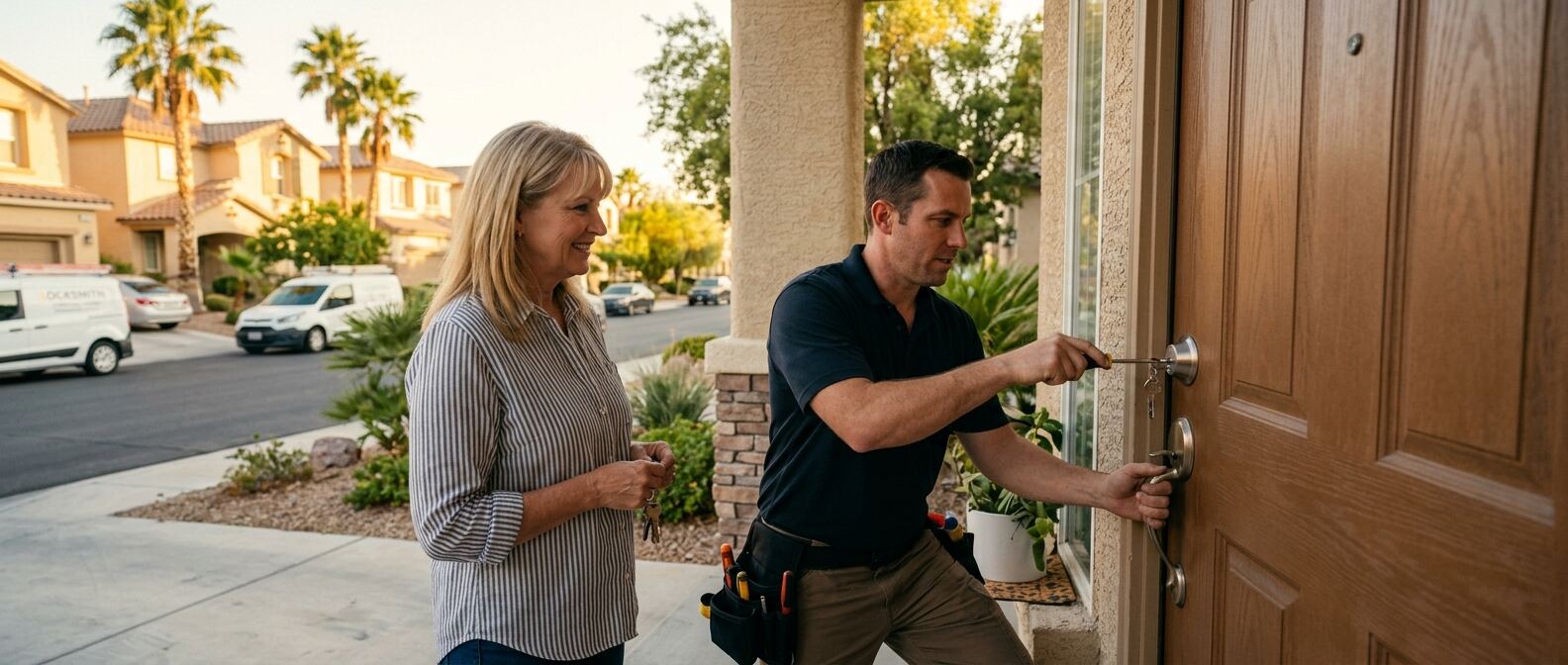
A good technician starts by figuring out whether the problem is the key, the cylinder, or the door — not by muscling the key harder. If the keyway is gummed with dust, they'll flush and lubricate it with a dry lubricant like PTFE or graphite rather than an oil-based spray, because oils attract more dust and make the problem worse a few weeks later in this climate. If the key is worn, they can cut a fresh one 'to code' or decode the lock and make a crisp new key that engages the pins properly. When the cylinder itself is failing, they can rekey it — replacing the internal pins — or swap the cylinder entirely, which is usually cheaper than replacing the whole lockset. And when the real issue is a misaligned door, the fix might be as simple as repositioning a strike plate or adjusting the bolt so the deadbolt seats without a fight.
There's a point where DIY jiggling starts costing you money. If you see metal shavings around the keyway, if the key visibly flexes or starts to bend when you turn it, or if the key has snapped off flush in the cylinder, stop — every additional twist raises the odds of a broken key stuck deep in the lock or a cracked cylinder, both of which are pricier to repair than the original problem. A simple lubrication-and-adjustment visit is typically far cheaper than a full lock replacement, so calling early usually saves money rather than spending it. As a rough guide, rekeying an existing cylinder is often quoted in the range of roughly $15 to $30 per cylinder plus a service-call fee, while a new deadbolt supplied and installed commonly runs somewhere around $100 to $250 depending on the grade of hardware — always confirm the total with your locksmith before work begins.
Most 'stuck key' calls in the valley trace back to a short list of causes. Fine desert grit is a big one — wind-driven dust works its way into the keyway over months and packs around the pins, so the key slides in but won't rotate cleanly. Wear is another: an older key that's been copied several times, or brass pins that have rounded off after years of daily use, no longer line up at the shear line. Heat plays a role too, since metal expands and a door that sits in direct afternoon sun can bind against its frame by late day. Finally, a lot of 'the lock is broken' complaints are really alignment problems — a door that has settled, a loose strike plate, or a deadbolt that only throws halfway because the bolt and strike hole no longer meet. Each of these has a different fix, which is exactly why forcing the key is the wrong first move.
A good technician starts by figuring out whether the problem is the key, the cylinder, or the door — not by muscling the key harder. If the keyway is gummed with dust, they'll flush and lubricate it with a dry lubricant like PTFE or graphite rather than an oil-based spray, because oils attract more dust and make the problem worse a few weeks later in this climate. If the key is worn, they can cut a fresh one 'to code' or decode the lock and make a crisp new key that engages the pins properly. When the cylinder itself is failing, they can rekey it — replacing the internal pins — or swap the cylinder entirely, which is usually cheaper than replacing the whole lockset. And when the real issue is a misaligned door, the fix might be as simple as repositioning a strike plate or adjusting the bolt so the deadbolt seats without a fight.
There's a point where DIY jiggling starts costing you money. If you see metal shavings around the keyway, if the key visibly flexes or starts to bend when you turn it, or if the key has snapped off flush in the cylinder, stop — every additional twist raises the odds of a broken key stuck deep in the lock or a cracked cylinder, both of which are pricier to repair than the original problem. A simple lubrication-and-adjustment visit is typically far cheaper than a full lock replacement, so calling early usually saves money rather than spending it. As a rough guide, rekeying an existing cylinder is often quoted in the range of roughly $15 to $30 per cylinder plus a service-call fee, while a new deadbolt supplied and installed commonly runs somewhere around $100 to $250 depending on the grade of hardware — always confirm the total with your locksmith before work begins.
Send a request through the site with your location and what you need, and you will get a straight answer and an honest estimate before any work begins.
Request service — tell us what you need and we will reply with a straight answer and an honest estimate.